- Dec 10, 2024
All I want for Christmas... is a sensible, logical Digital Technologies curriculum for WA
- Courtney Weaver
- 0 comments
As the 2024 school year draws to a close, it's time to take a moment to reflect, rest and recuperate. In terms of reflection, 2024 marks 6 years into the compulsory implementation of the Digital Technologies curriculum in WA for all students from Kindy to Year 8. By now, we would hope to be seeing students entering high school with fundamental computational thinking skills and the ability to implement programs in Scratch or other block based languages. We would also ideally be seeing larger numbers of students undertaking Digital Technologies related courses in senior secondary, either in a General or ATAR pathway. This hasn't happened, with enrolments in General and ATAR Computer Science and Applied Information Technology remaining at about 5% of total year 12 enrolments from 2018 through to 2023.
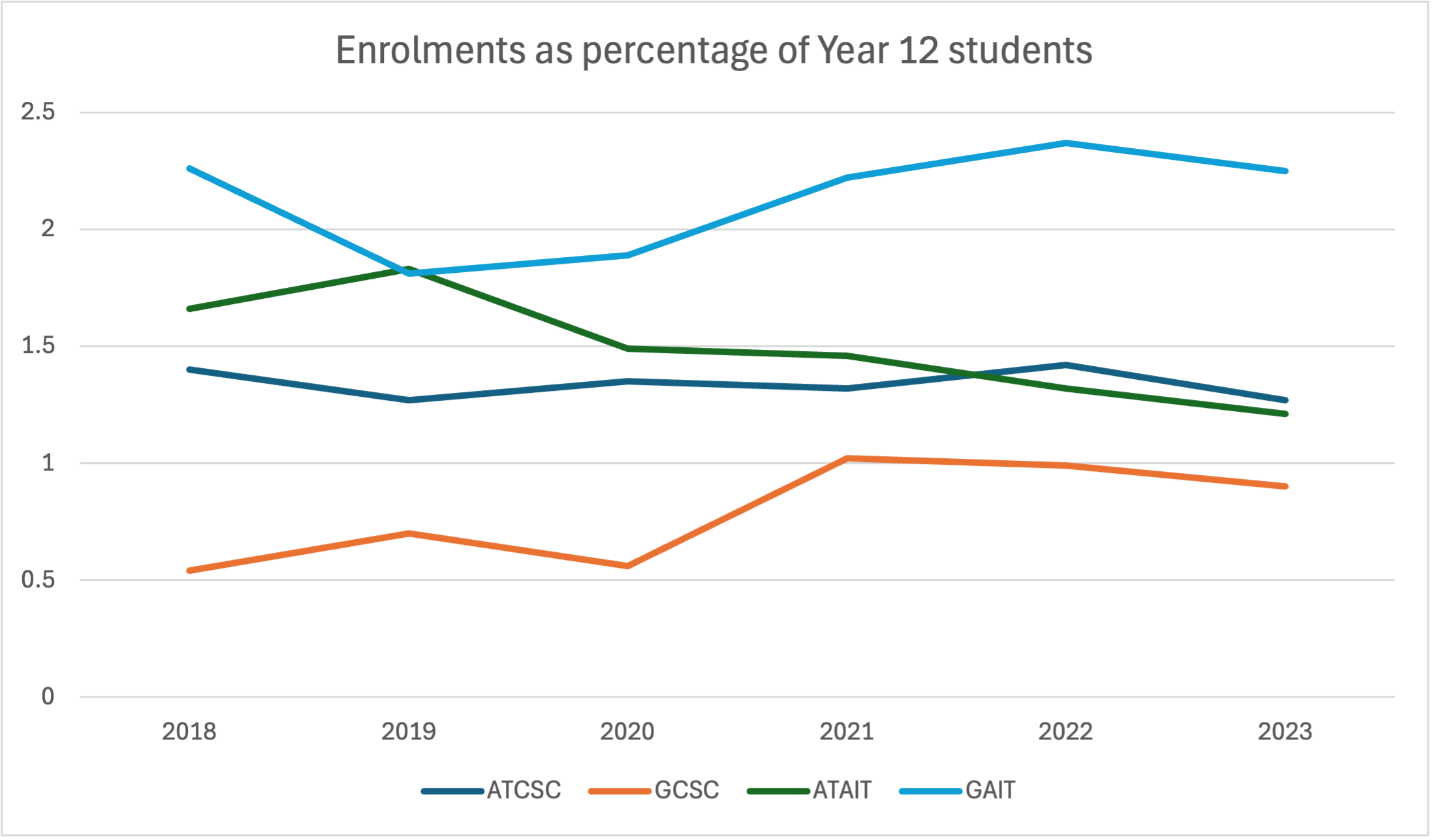
Source: SCSA Table 3.2 Number and percentage of Year 12 students awarded grades for WACE course units by gender 2019-2023.
Thankfully, 2024 saw the opportunity for SCSA to consult with teachers after producing the draft new curriculum, based on the Australian Curriculum version 9 released by ACARA in May 2022. What a great opportunity to look at what has worked and what hasn't in the implementation of the curriculum since 2018 and look at how we can make the expectations of teaching and assessing in this area clearer. After submitting my feedback on the new curriculum, particularly in the secondary space, and now awaiting what will be released for familiarisation in 2025, I thought I would write up my Christmas wish list for the new curriculum that would make it easier for teachers to understand and therefore be able to teach.
Understanding of the practicalities of delivering the subject
The Australian Curriculum, by having 2 year level bands grouped together and an expectation of what students will know and be able to do at the end of each of those 2 year bands, gives schools and teachers flexibility in how they break up content over the two years to allow for students to go deep or wide in each year. This can cause problems with students changing schools or for teachers working in different year levels in primary schools however, where they may miss content or be exposed to the same thing twice.
The WA curriculum addresses this by breaking up the year levels within the band explicitly. The way in which it is broken up, however, does not account for how the subject is often taught in practice. Schools are only required to report on Digital Technologies achievement in one semester each year. As a result, most secondary schools offer Digital Technologies as a semester long subject in Years 7 and 8 and many primary schools do the same, although some will integrate it with Design and Technologies and teach it throughout the entire year. As a result of this semesterisation of courses, it is entirely possible for students to spend 12 consecutive months without being exposed to any of the Digital Technologies learning area content.
This long break will often require that students need to be re-taught the previous year's content in detail, adding pressure to teachers attempting to cover the current year's content in the allocated time. Most teachers therefore resort, by having to cover every aspect of the curriculum each year, to merely scratching the surface on each topic area. By breaking up the content more logically, particularly in the knowledge and understanding strand, this would allow teachers to spend time going deeper into the content of each aspect, contributing to improved retention of previously learnt content and laying a strong foundation to build upon.
For example, solidifying the data representation content lays an important foundation for networking so breaking up the curriculum into Data Representation in Year 7 followed by the networking concepts in Digital Systems in Year 8 would allow a sound logical progression both from a content and pedagogical perspective.
Logical progression with consistent terminology
As a secondary educator, I had not taken much time to review the primary curriculum beyond cursory glances to identify what students should know when coming into Year 7. I recently looked at the entire curriculum from Kindy to Year 10 to identify how the various programming concepts are laid out in the WA Curriculum compared to the Australian Curriculum. In doing this, I discovered that there is a lack of consistent terminology and logical progression in our curriculum. Additionally, the term "implementation" is used to mean different things within the curriculum, adding additional complexity. In the Australian Curriculum, Algorithms and Implementation are two concepts with Algorithms being the computational thinking aspects of the solution design and implementation being the translation of those algorithms into code. In the WA Curriculum, we have Digital Implementation as a strand of the curriculum, as well as part of the "Creating Solutions by... Producing and Implementing" shared content descriptions with Design and Technologies.
Let's take a look at some specific examples of how the progression is confusing in the current WA Curriculum.
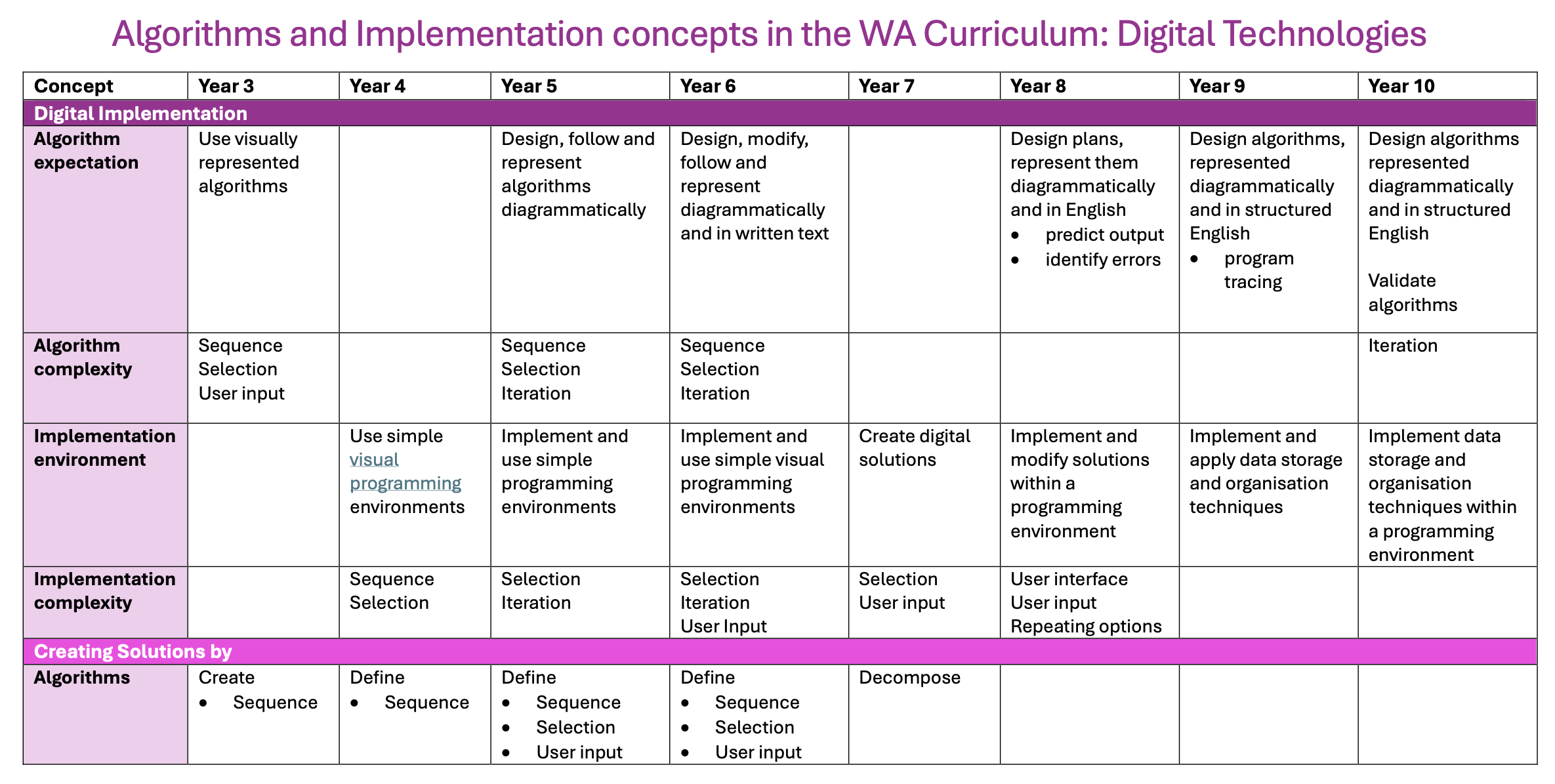
Straight away, I am drawn to the inconsistency in the Implementation environment.
In Year 4 we are asking students to use a "simple visual programming environment"
In Year 5, it is a "simple programming environment"
In Year 6 we return to the "simple visual programming environment"
In Year 7 and Year 9, there is no programming environment specified at all yet students still need to create and implement things
In Year 8 and 10 we need students to use a "programming environment"
Is it just a typographical error to omit the word visual from the Year 5 description? Does the omission of the word "visual" from years 8 to 10 signal to teachers that a block based coding language is no longer enough for these years? How do students create and implement solutions without a programming environment? Is prototyping enough in these years? How will students develop and retain programming skills when only doing this every second year?
Clarity in these areas by using consistent, meaningful terminology would make it much easier for teachers to understand their requirements when delivering the curriculum.
Other things that I hope are addressed in the new WA Curriculum that are confusing in the current version are:
Inconsistency between what is expected in the Digital Implementation and Creating Solutions by levels of complexity, control structures used
The fact that year 7 students are required to implement a program without having designed (and again, without any environment in which to implement)
No guidance on the level of progression for algorithmic complexity beyond year 5 when they have learnt sequence, selection and iteration (multiple selection, nested control structures, functions, object oriented principles)
How do students implement a programming environment? They USE a programming environment to IMPLEMENT the algorithms in code so the distinction between year 4 and 5 is very unclear.
Subject specific vocabulary
The WA Curriculum has taken great pains to obfuscate many computer science specific terms in an aim to make the curriculum seem less daunting for teachers who may not have the relevant technical or content background. Ironically, I believe this has contributed to the confusion that teachers experience because they are unable to research for the terms found in the WA Curriculum.
We see this in the use of the term "sequence of steps" instead of the word algorithm. The word algorithm is often placed in brackets after the words "sequence of steps", as can be seen in this content description for year 4:
Use simple visual programming environments that include a sequence of steps (algorithm) involving decisions made by the user (branching)
This makes it seem that algorithms are sequence, and that branching is something altogether different instead of the fact that these are 2 of the three principle control structures that all algorithms are made of. Trusting the professionalism of teachers by using the word algorithm consistently throughout the curriculum and providing adequate glossary assistance would make it much easier for teachers.
In the Year 10 content, students are being asked to implement data structures in a programming language however, Object Oriented Programming (OOP), the principle reason why you would implement data structures in a programming language is not mentioned. Also, by not calling this out it is unclear what students are preparing for in Year 9 when they are being asked to implement these without a programming language - although that is addressed above. Given OOP is explicitly in the Year 11 and 12 Computer Science curriculum, let's call this out in our Year 9 and 10 content and link the pathway.
In year 8, we see the following which seems to be avoiding using the terms branching, iteration and user input despite the fact they are used elsewhere in the curriculum:
Implement and modify solutions, that include user interfaces within a programming environment, including the need for choice of options and/or repeating options
I have to admit that I'm not entirely sure what this ACTUALLY means. The related content description in the Australian Curriculum (v8.4) is ACTDIP030 which states:
Implement and modify programs with user interfaces involving branching, iteration and functions in a general-purpose programming language
I think, however, that the WA description has been adapted from one of the associated elaborations:
creating digital solutions that provide user navigation and prompts with controlled repetitions, for example an information kiosk that has layers of buttons and prompts the user three times before returning to the beginning
Whilst the term "controlled repetitions" can still be confusing, because this is an elaboration, there is an example provided which gives clarity, unlike the very confusing "choice of options and/or repeating options".
Alignment with Australian Curriculum
Ultimately, I am frustrated that we feel the need to adapt our curriculum so extensively. We are not a large enough jurisdiction to justify the creation of unique resources which ultimately means that there is additional work for teachers to try to align the Australian Curriculum resources that exist on sites such as the Digital Technologies Hub and understand them when our terminology is so inconsistent.
The concept of what an algorithm is or how to program one in a language does not change over state lines. There is no real content in our curriculum that is dependent on the uniqueness of our state and as such, most of the changes seem to have been made quite meaninglessly for the sake of putting our stamp on it. It's still entirely possible to contextualise the national content to WA in HOW we deliver it, the problems we give students to solve and the examples we choose to give but the content descriptions themselves, the underpinning concepts and the overall structure should be consistent.
I also like the additional information on algorithmic complexity which is found in the Australian Curriculum version 9.
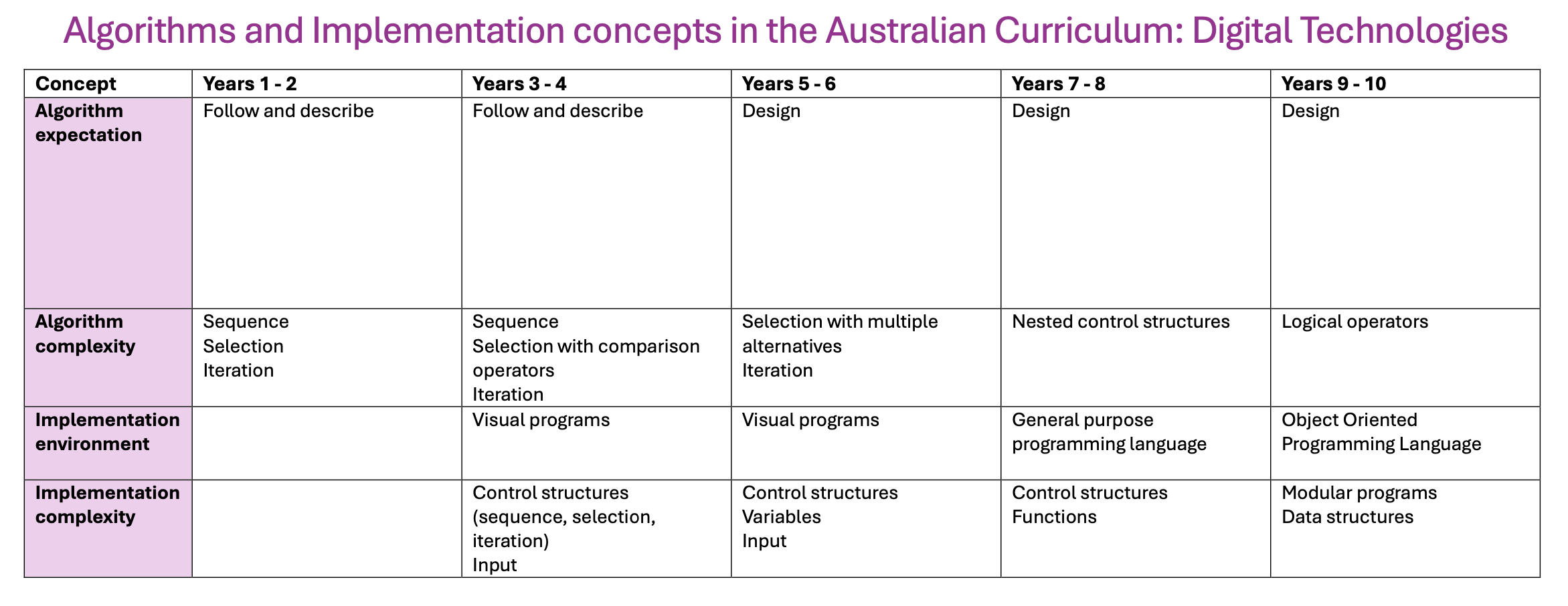
New curriculum for familiarisation in 2025
Some of the issues I have raised here look to be addressed in the new curriculum however, in the draft version at least, many issues remained and there were also new issues created by the shoehorning of privacy and security content into digital systems and data representation. I look forward to the new release for familiarisation, hoping that the concerns have been listened to and addressed.
Need help implementing the Digital Technologies curriculum?
I work with schools and teachers to build their capacity in Digital Technologies and Digital Literacy. Get in touch to see how I can help you with familiarisation of the new curriculum in 2025.